Build Go Software
That Lasts in Production
A practical guide to test-first design, security, reliability patterns, and real-world deployment — using Go as the vehicle.
Every purchase of an individual license includes both PDF + EPUB formats. DRM-free
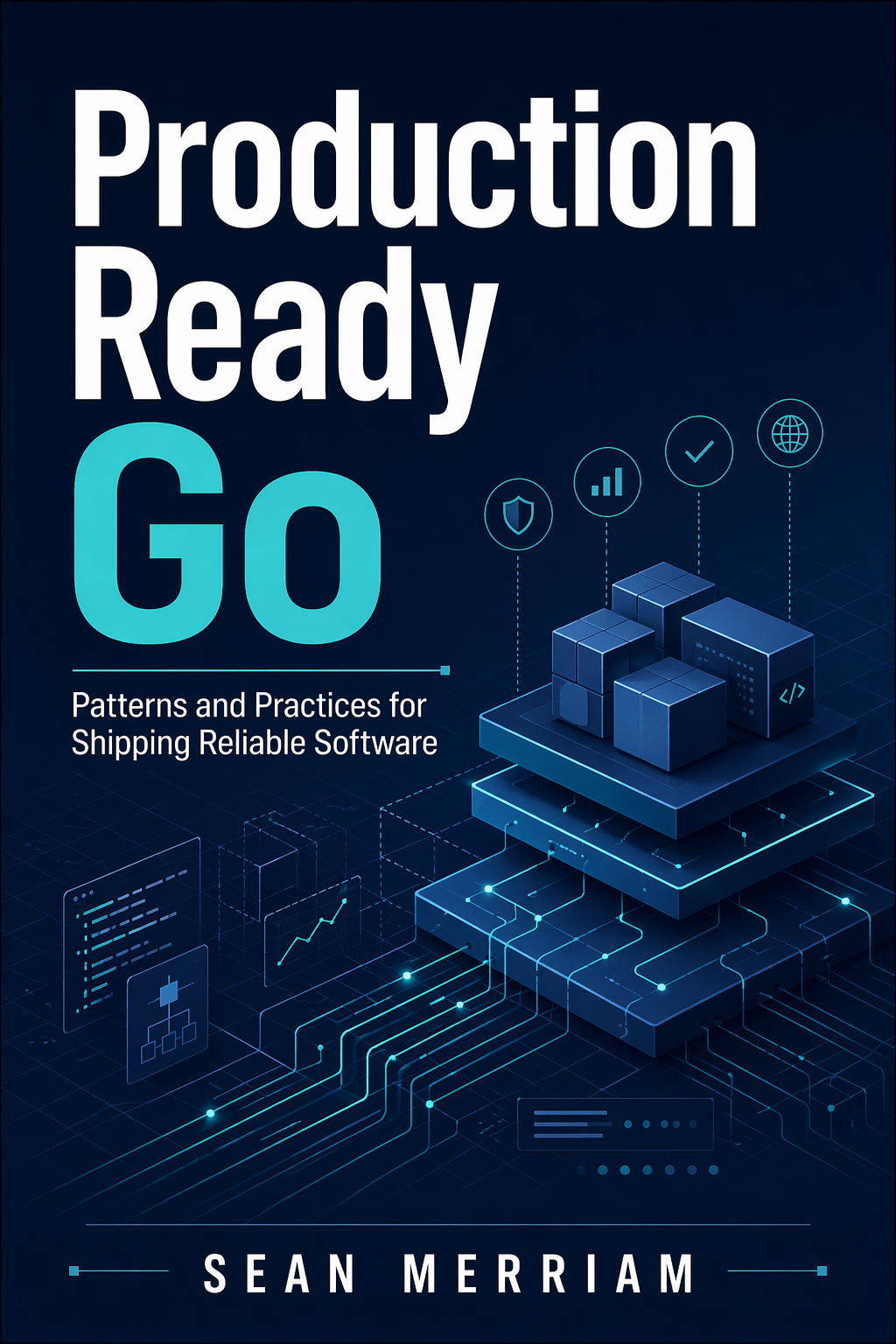
Table of Contents
A complete progression from foundations to full production operation
- 0 Testing Primer for Go Learners
- 1 The Test-Everything Mindset
- 2 Go Reliability Patterns & Core Semantics
- 3 Advanced Testing Techniques
- 4 Security-First Development
- 5 Database Operations & Testing
- 6 HTTP Servers & API Design
- 7 Error Handling & Logging
- 8 Concurrency & Parallelism
- 9 Project Structure & Organization
- 10 CMS Architecture & Setup
- 11 Backend User Management & Auth
- 12 Backend Content Management
- 13 Backend API Layer & Middleware
- 14 Frontend Integration Patterns
- 15 Deployment, Monitoring & Maintenance
Who This Book Is For
Honest expectations help you decide before you buy
You'll get the most from this book if…
- You write Go and want services that survive contact with production
- You want testing, security, and reliability woven into how you build, not bolted on
- You're comfortable reading code and want concrete patterns, not motivational fluff
- You're moving from solo scripts to systems people depend on
- You want one coherent capstone that ties every concept together
This book is probably not for you if…
- You've never written a line of Go (start with the Tour, then come back)
- You want a syntax cheat sheet — this is about engineering practices
- You're looking for framework tutorials with minimal explanation
- You don't believe testing or operational concerns are part of "the code"
Inside the Book
A taste of the writing and the code
“Reliability is not a feature you add at the end. It is the cumulative effect of decisions you make every time you name a variable, draw a module boundary, or write a test. Production-ready code is honest code: it tells the truth about what it does, what it depends on, and how it can fail.” — From Chapter 1, The Test-Everything Mindset
// Table-driven test: each row is a named scenario, run in isolation.
func TestUserService_Register(t *testing.T) {
    tests := []struct {
        name    string
        input   RegisterInput
        wantErr error
    }{
        {"valid input creates user",    validInput(),     nil},
        {"duplicate email is rejected", dupEmailInput(), ErrEmailTaken},
        {"weak password is rejected",   weakPassInput(), ErrWeakPassword},
    }
    for _, tc := range tests {
        t.Run(tc.name, func(t *testing.T) {
            t.Parallel()
            svc := newTestService(t)
            _, err := svc.Register(ctx(t), tc.input)
            if !errors.Is(err, tc.wantErr) {
                t.Fatalf("got %v, want %v", err, tc.wantErr)
            }
        })
    }
}
What You'll Learn
16 chapters and 695 pages that build from testing foundations to full production operation
Test-First Engineering
Red-green-refactor, table-driven tests, fuzz testing, and coverage analysis from day one.
Security by Default
Input validation, SQL injection prevention, JWT auth, and XSS/CSRF protection built in.
Production Architecture
Repository pattern, concurrency, HTTP middleware, and project structure that scales.
Database Reliability
Schema design, transactions, connection pools, and full database testing strategies.
Deploy & Operate
CI/CD, observability, incident response, and ongoing maintenance workflows.
CMS Capstone Project
Every concept applied to a real content management system with a React frontend.
Frequently Asked Questions
What formats are included?
Both PDF (print-quality, letter size, embedded fonts) and EPUB 3 (Kindle and Apple Books compatible, with a navigable table of contents and syntax-highlighted code). Every purchase includes both — no upsell.
Is the book DRM-free?
Yes. The files are yours: read them on any device, back them up, print pages, and keep them forever. We trust you.
What level of Go experience do I need?
You should be comfortable writing basic Go — defining structs, using slices and maps, calling standard-library packages. If you've completed the Tour of Go and shipped a small program, you're ready.
Chapter 0 is a focused testing primer for newer Go programmers; later chapters are intentionally more advanced.
What Go version does the book target?
Go 1.24. The patterns are evergreen and apply to any modern Go release; the only places version matters are tooling configuration and a few standard-library APIs, which are called out where they appear.
Is there source code I can run?
Yes. Every chapter includes self-contained, runnable examples, and the second half of the book builds a complete CMS — backend in Go, with a framework-agnostic React reference frontend — that you can clone, run, and extend.
Do I get free updates?
Yes. Anyone who buys this edition receives every revision and corrections release for the same edition at no additional cost.
Can I read a sample first?
Absolutely — download Chapter 1 as a free PDF. It's a good test of whether the writing style and depth fit how you like to learn.
What's your refund policy?
If the book isn't a good fit within 30 days of purchase, email us and we'll refund you in full — no forms, no friction.
Do you offer team or company licenses?
Yes. For small teams, we offer multi-seat licenses at a discount; for larger orgs, contact us for a site license that covers everyone in your engineering org. Reach out via the email in the footer.
Get the Book
One-time purchase · DRM-free · Yours forever
$39
One-time · 1 seat
- PDF + EPUB — both formats included
- 16 chapters, exercises & examples
- CMS capstone project with source
- Free updates to this edition
$150
One-time · 5 seats
- Everything in Individual × 5
- Share with your whole team
- Single purchase, five readers
- Free updates to this edition
Need more seats? Email us